Simulation Framework
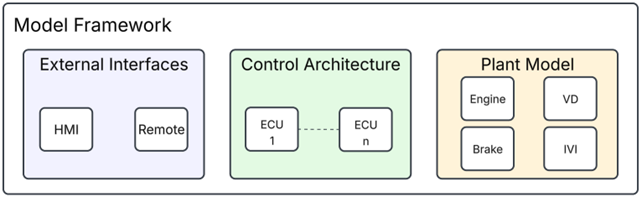
In the development and testing of embedded ECU software, model-based frameworks are essential tools that allow algorithm and software engineers to validate their solutions within a fully virtualized vehicle environment. These frameworks are typically structured around three key simulation subsystems:
- External Interfaces
- Control Architecture
- Plant Model
Together, these components provide a comprehensive platform for simulating real-world vehicle behaviour and interactions, enabling efficient and robust software validation.
External Interface
The External Interface block serves as a gateway for injecting input signals into the model framework, enabling interaction with external stimuli. Depending on the application this could represent driver manoeuvres, user interactions, externally provided setpoints or profile to be replayed.
Control Architecture
The control architecture subsystem encompasses all simulated Electronic Control Units (ECUs) that implement the required system functionality by controlling the system according to the external interfaces. At an early stage of development, this subsystem contains the control algorithms and strategies that will later be embedded in the real controller. Common examples in the automotive sector are:
- Trajectory control
- ADAS functions
- Traction and powertrain control
Plant Simulation
These subsystems represent a lumped-parameter model consisting of multiple interconnected subsystems, each representing the behaviour of a specific aspect of the system we need to control to implement the desired functionalities. Common automotive examples are:
- Powertrain model
- Vehicle dynamics equation
- Braking systems